Wednesday, May 16, 2012

Normandy Countryside

Beyond the history lesson, the trip was worth it just for the opportunity to ride around the French county side. Narrow lanes, fields boarded by hedgerows, old stone farmhouses, and vibrant yellow fields of canola were every bit as picturesque and charming as they sound. According to our guide, Adrian, Norman cows are very friendly and curious (in sunglasses - see pic), a trait the Americans used to their advantage in the war. If the GIs saw a field of cows clustered around an otherwise empty looking patch of field, it was a big tipoff that German soldiers were hiding there!
Some how I think Jessie gets his hair coif'ed at the same place as this cow. From our car window we flew past field after yellow field of canolla flowers. This photo does not do the countryside justice.

Tuesday, May 15, 2012

Small Strokes of Luck

I was struck by how many events were impacted by small stokes of luck and chance. An example of good luck -the convergence of a low tide and a full moon dictated the invasion happen in June. The timing meant that the Allies attacked before the Germans had finished fortifying their newly built bunkers with cannon. Had the Allies waited until September (the next time a full moon and low tide occurred),it would have been a very different battle, because the bunkers would have had their full compliment of arms. More examples...a shell serendipitously hit a section of the cliffs at Omaha beach, causing a huge avalanche of stone. The avalanche essentially formed a stone ramp that made the cliffs at Omaha beach easier to scale-good luck. The weather was bad, so the Allied troops were held out at sea in the landing craft overnight, leaving the soldiers cold, hungry, and seasick- bad luck. A huge house fire broke ou the night before the invasion, when paratroopers were to land under the cover of darkness and set flares for the gliders that were supposed to deliver troops the next day. The fire lit up the night sky, ensuring all the German soldiers were outside trying to put out the fire and making the paratroopers easy targets- bad luck. It just goes on and on- even with all of the planning the US military put into the invasion, individual soldiers lived or died based on happenstance. I just kept thinking of all the mother and fathers, wives and children, whose lives were changed forever because of some small element of chance Stiking too, was seeing just how tiny a toehold the Allied forces began the liberation of Europe. Hitler held the territory all the way from Norway down to the south of France, and the Allies began the eventual undoing of the 3rd Reich with a swath of land that you could easily walk, end to end, in less than a day.
The first picture in this post is of a landscape scared with 70-year old bombing divots. 70 years ago, the coast would have been marred with much deeper holes from the Allied bombing. The second picture is of a German bunker which at the time had the large cannons, but did not have ventilation and sighting components completed at the time of the "embarqement". In the background you can see a field of canola flowers found all over Normandy and Britany (more pictures to come of these fields).
One of the German cemeteries in Normandy. Our guide Adrian pointed-out that most of the German soldiers that lost their lives in the war had no desire to fighting for Hitler, but they had no choice. It was said that it was better to be an German POW than a German soldier, as the Americans treated their POWs better than Hitler treated his army.

Paris to Bayeux

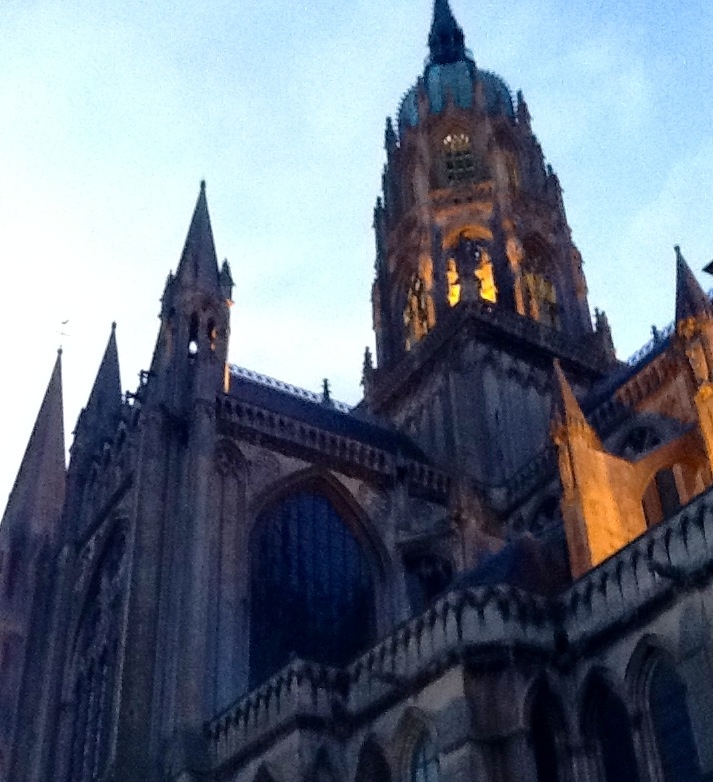
Wednesday, May 9th: At 8pm, we left our busy schedule in Paris on the train north to a small town in Normandy called Bayeux. We arrived after 11pm and walked a half mile from the train station in a light mist to our hotel-Hotel de la Rein Mathilde. In the center of this small town stood an enormous, beautifully lit and almost out-of-place cathedral. After the giddy high of Paris, with the crowds, bustle and old-time royal oppulance, NOrmandy was a welcome yet somber change of pace. Early Thursday morning we set out on a tour of WWII sites. The liberation of France by the Alies is an integral part of the identity of the Normans, just like dairy products such as Canembert cheese, sparkling hard apple cider and Calvados, a liquor that will burn all the way down. We saw Utah beach (a success marred by 80% casualties in the first and second waves to land), a German cemetery, the American cemetery and memorial, and the town of St Mere Eglise (featured prominently in the 1960s movie The Longest Day because of its prominence in the actual invasion).

The Louvre-Second Half of D&B's Afternoon

After the Musee d'Orsay, Dave and Barb walked over the bridge to the Musee du Louvre--it is amazing how may of the famous sites in Paris are so close to one another. You can't swing a cat without hitting some famous something or another! We again across the bridge with all of the lockes to the ironwork--lovers affix a lock on to the bridge and toss the key into the Seine River as a symbol of their undying love How romantic! Like the Musee d'Orsay, it is the museum's perogative to move exhibits around, so D&B enjoyed a lively game of "Where's Waldo" with the Mona Lisa and Venus de Milo. We just followed the crowds to find Winged Victory, a strategy we should have used through the entire museum. Art could be it's own category of "things we wish I knew more about (see my earlier blog). As we walked through the Louvre, I could not shake the feeling that I was racing past once in a lifetime artwork without the slightest appreciation for what I was seeing. Maybe in my next life I will come back as an art history major. We had been prepped ahead of time to expect the Mona Lisa to be small and hard to see (partly because of crowds and partly because of the protective glass), but I was reminded of the statue of David in Florence. When you see these masterpieces, it is not hard to understand why their appeal has endured for so long. One of our tour guides mentioned that if you stood for just three seconds in front of each pieced of art in the Louvre's collection, it would take you three months (24 hours per day) to see the entire collection. No wonder we were overwhelmed. Another (under-appreciated, in our case) aspect of the tour is the building itself. While Chateau du Versailles was intended to replace the Louvre as the royal palace, it certainly did not outshine it. Dave commented that, except for the extensive grounds of Versailles, Louis Louis XIV traded down when he moved out to the country!

Friday, May 11, 2012

Dave and Barb Go Their Own Way

E and K did their own tour, and left early to meet Olivier Maloisel for lunch (more on this elsewhere), so B and D ate lunch in the restaurant of the Musee d'Orsay. The museum used to be a train station, and the restaurant was original to the building. Unlike many museum restaurants, this one wasn’t tucked away in the basement, but was upstairs in a light filled room with mirrors opposite the windows and crystal chandeliers. Felt like we were eating at Versailles!

Thursday, May 10, 2012

More to Come

Today from our small town with an enormous church, we traveled out to the Normandy coast to see the WWII sites here including: Utah Beach, Omaha Beach and the WWII American Cemetery of Normandy. These 9,800+ American women and men were true heros who fought for freedom on the other side of the world from their US homes, and gave their lives. Amazing!

Splitting Ways

Wednesday we all got up, and headed to the other side of the Seine River. We started at Poiline Boulangerie where there were beautiful baked goods… Dave and I had pain au chocolate like it was supposed to be, Katie had a plain croissant and Barb had a mini baguette. All were very good… how are flour, water and butter so different here than in the US. We then headed to Musee d’Orsay to see the most incredible collections of Monet, Manet, Pissarro, Renoir, Gauguin, Van Gough and more. Katie and I did the power-art version of going through the museum at break-neck speed, as she was joining me to meet a former friend/boss of mine from when I did my internship. Meanwhile, D&B took a more leisurely tour of the Musee d’Orsay, with plans to visit the Mona Lisa in the Louvre Museum later that day. Olivier Maloisel hosted Katie and me at Le Bistro du 7eme for a very traditional French lunch. We dined for 2.5 hours, having some wine, salads, baguette slices, entrees, dessert… and good conversation. He continued to be amazed at how much we were attempting to see on our short trip to France. I believe it was the first time we were in a restaurant with nothing but francophones. It was a great opportunity to get caught up with a very good man. He hopes to return to the US for a driving tour along Route 66, and hopes to have some “must-see" provided by me for his next visit. He is always welcome! From lunch we (Eric, Katie and Mr. Maloisel) took the Metro to the Opera station. We were in search for the Pierre Herme patisserie shop to pick-up some macaroon cookies---OMG you thought Cheryl's Cookies were expensive!